
Seatrade-Maritime: Uneven container line reliability picture masks performance gains

Published by Seatrade-Maritime
Overall punctuality figures remain poor on eight of the world’s regional container liner trades, but while some operations are showing improvements, in terms of delays that progress is at best uneven.
Data in Xeneta’s Quarterly Reliability Report, published at the end of July, showed both the East Coast South America and Far East to Europe trades made double-digit improvements on reliability, 17% and 13% respectively; while both Oceania and Africa saw marked declines; and the Middle East trades improved 5%, but that was to just 25% punctuality.
Both the Middle East and Africa recorded average delays down by about half a day to 4.9 and 4.1 days respectively, Oceania’s average delays worsened to 3.3 days, up 0.8,
On the three major trades both the Far East to US and transatlantic have seen reductions in blank sailings, with reliability up to 42% and 41% respectively and delays down to 2.2 days in both trades.
According to Xeneta the transpacific recovery remains the most credible in terms of its reliability of the three major east-west trades.
“Blank sailings on Far East–North America fell from 17% to 10% of planned teu year-on-year in Q2. Yet reliability still rose, meaning carriers improved schedules and operations, not just reduced their load. Those gains do not give ground as easily under sustained pressure,” claimed the report.
Nevertheless, Xeneta also pointed out that Pacific carriers used ‘proforma padding’, adding days to schedules to limit late arrivals, which had, “A bigger role in managing schedule recovery than blanked sailings,” according to the report.
On the Atlantic carriers have been cutting the amount of blanked capacity every month since April, “Services out of Northern Europe, which see market share dominated by Gemini and MSC, closed June with just 2% of planned teu blanked, the lowest of any east-west corridor since July 2024,” according to Xeneta data.
While on both the Atlantic and Pacific trade lanes capacity cuts have significantly reduced and reliability improved the same is not true on the Far East–Europe, which has seen a “recovery [that] still leans more on what carriers cut than on how well they operate,” noted Xeneta.
In the first quarter the Far East to Europe services fell to 25% reliability, recovering in Q2 to 38% with an average of 2.9 days delay.
“Far East–Europe is the outlier: carriers cut 22% of planned teu in March alone with the impact of the Middle East conflict combining with seasonal Chinese New Year capacity withdrawal,” said Xeneta.
Improvements in services from the Far East to Europe are being seen, however, with June seeing a blanked teu down to 8%, below the 9% seen in June 2025, “and the first clear year-on-year improvement in Q2.”
Far East to Europe on time percentages (OTP) were helped by fewer Arabian Gulf calls and a reduction in port disruptions allowed carriers to boost reliability by 13% to 38% overall.
South America West Coast (SAWC) and South America East Coast (SAEC) were the best performers, reaching 52% and 59% OTP, with SAEC improving by 17%. Both trades saw average delay days fall to 1.8.
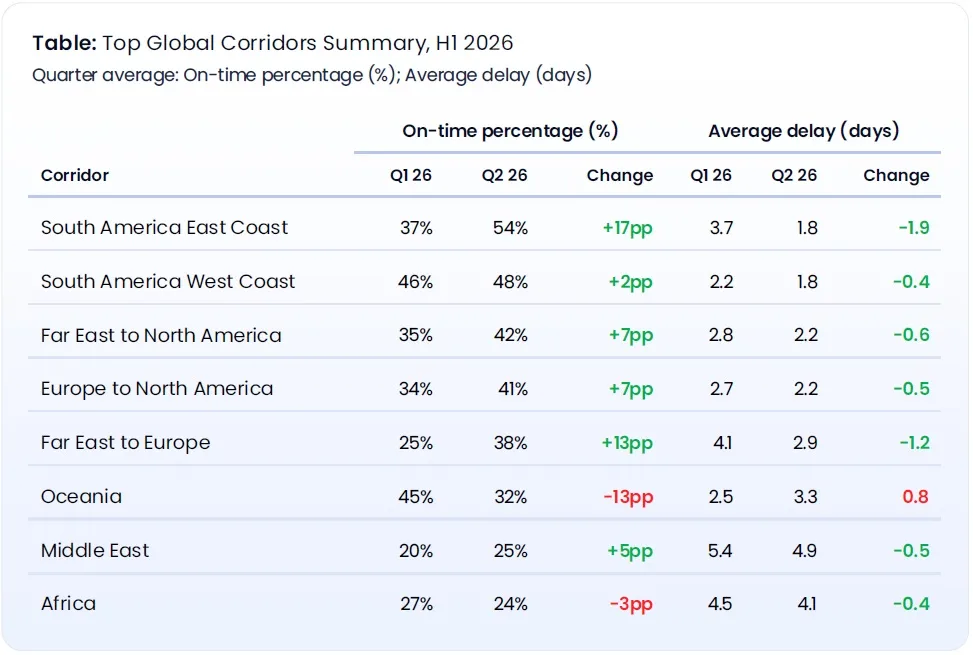
Courtesy of Xeneta
Xeneta did point to improvements in reliability in Q2 over Q1 as the Iran war began in very late February, though the report cautions: “Many carriers continue to use blank sailings to offset delayed voyages and prop up reliability.”
The Quarterly report used carrier transit time information to compare real-time sailing durations to published schedules. Xeneta calculated on-time percentages if a vessel arrived at its destination port within 24 hours of the published date and time.
“Carriers can improve both metrics by padding schedules or introducing blanked voyages without changing operations,” warned Xeneta.
Related Posts


